
Dietary Fibre and Gut Health: Implications for Colorectal Cancer Risk Reduction
10-Second Takeaway
Dietary fibre intake in the UK remains substantially below recommendations, despite strong evidence linking higher fibre consumption to improved gut health and lower risk of colorectal cancer. Fibre supports bowel function and the gut microbiome, producing beneficial metabolites such as butyrate that help maintain intestinal integrity and regulate inflammation. Encouraging a variety of fibre-rich plant foods, including wholegrains, legumes, fruits, vegetables, nuts, seeds, alongside gradual increases and adequate hydration is a practical, sustainable approach for clinicians to support colorectal health.
Introduction: Fibre & Cancer Prevention
Dietary fibre has long been recognised as a key component of a healthy diet, yet many people do not consume enough to meet recommended targets. In the UK, government guidelines recommend an intake of 30g of fibre per day for adults, but population surveys show that average intakes are considerably lower – typically around 16g per day.
Colorectal cancer remains one of the most common cancer types globally, and modifiable lifestyle factors, including diet, play an important role in shaping risk. Epidemiological evidence demonstrates an inverse association between higher dietary fibre intake and colorectal cancer incidence. Large cohort and meta-analytic data suggest that for every 10g/day increase in total fibre intake, the risk of colorectal cancer may be reduced by around 11%. Importantly, wholegrain and cereal fibre sources often show particularly consistent protective associations in research. These findings are biologically plausible. Fibre supports bowel function by increasing stool bulk and reducing transit time, while also interacting with the gut microbiota. Fermentable fibres are metabolised by gut bacteria to produce short-chain fatty acids such as butyrate, which help to maintain gut barrier integrity and may modulate inflammation. Understanding what fibre is, the different forms it takes and how it supports gut health is essential for translating this evidence into practical, sustainable dietary advice in both clinical and public health contexts.
Dietary Fibre Explained
Dietary fibre refers to the indigestible parts of plant foods that pass through the small intestine largely unchanged. Unlike carbohydrates such as sugars and starches, fibre cannot be broken down by human digestive enzymes. Instead, it reaches the large intestine, where it contributes to stool formation and interacts with the gut microbiome.
Fibre is naturally found in foods such as:
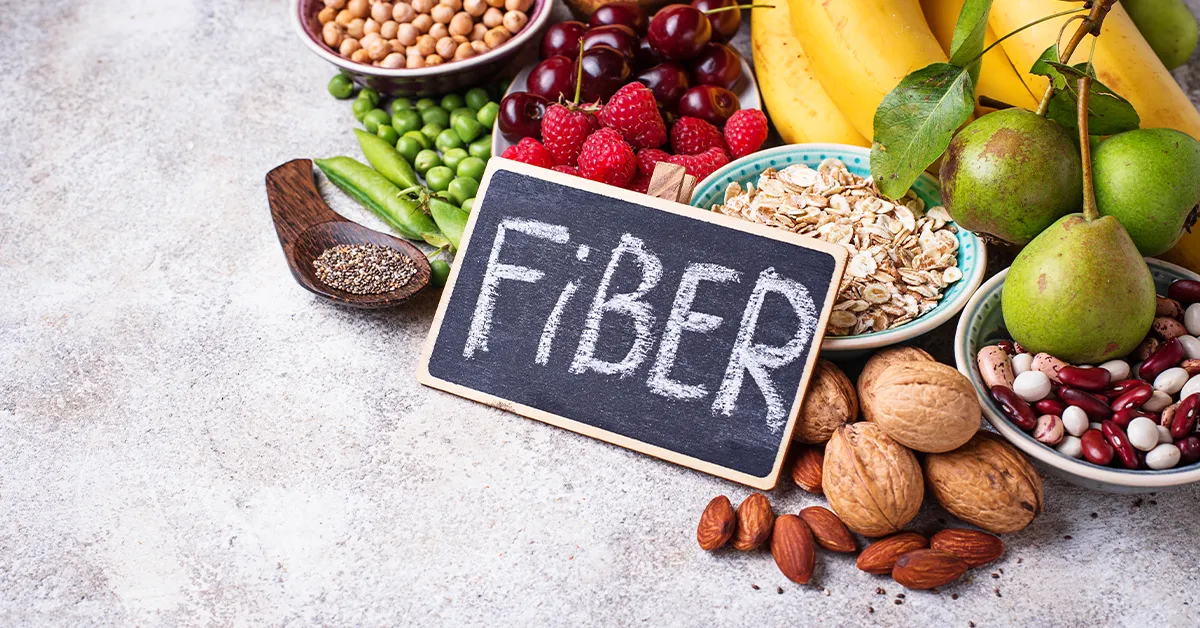
- Wholegrains (e.g., oats, wholemeal bread, quinoa)
- Pulses and legumes (e.g., lentils, kidney beans, chickpeas)
- Fruits and vegetables (e.g., berries, pears, broccoli)
- Nuts and seeds (e.g., almonds, walnuts, chia seeds)
Although often discussed as a single nutrient, fibre is a broad category with diverse physiological effects. Different fibres vary in their structure, fermentability and function within the gut. Fibre is often categorised into types such as:
- Soluble fibre, which dissolves in water and can form gels (e.g., oats, beans)
- Insoluble fibre, which adds bulk to stool and supports bowel motility (e.g., wheat bran, wholegrains)
- Fermentable fibres, which are broken down by gut bacteria to produce beneficial metabolites (e.g., onions, garlic, banana)
Rather than focusing on a single type, evidence supports the importance of consuming a wide variety of fibre-rich plant foods, as different fibres contribute to gut and metabolic health in complementary ways.
As with all fibre interventions, gradual increases and adequate hydration remain essential to support bowel function and tolerance. Fibre absorbs water in the gut to form softer, bulkier stools; without sufficient fluid intake, increasing fibre too quickly may worsen constipation or discomfort.
The Importance of Fibre for Gut Health
Fibre plays a central role in maintaining a healthy gastrointestinal system. One of its most immediate functions is supporting regular bowel movements by increasing stool bulk and promoting motility. Equally important is fibre’s interaction with the gut microbiota. When fermentable fibres reach the colon, they are metabolised by beneficial bacteria, producing short-chain fatty acids, such as acetate, butyrate and propionate.
These compounds help to:
- Support the integrity of the gut lining by serving as a primary energy source for colonocytes, strengthening the intestinal barrier and reducing gut permeability.
- Modulate inflammation through effects on immune signalling pathways, which may help maintain a healthier colonic environment and reduce chronic low-grade inflammation.
- Promote a favourable microbial environment by encouraging the growth of beneficial bacterial species and supporting greater microbial diversity, both of which are associated with improved gastrointestinal health.
- Potentially influence mechanisms relevant to colorectal cancer risk, as butyrate has been shown to play a role in regulating cell growth, differentiation and apoptosis (cell-death) in the colon, providing a plausible biological pathway through which higher fibre diets may contribute to reduced colorectal cancer incidence.
Fibre Supplements: Are They a Useful Alternative?
With growing awareness of gut health, fibre supplements and prebiotic powders have become increasingly popular. Products containing psyllium husk, inulin, wheat dextrin or resistant starch are often marketed as an easy way to “boost fibre intake”, particularly for individuals who struggle to meet recommendations through diet alone.
In some cases, supplements may offer a practical short-term option. Psyllium, for example, has evidence for improving stool regularity and supporting bowel function, particularly in individuals suffering from constipation. For individuals with very low dietary fibre intakes, reduced appetite or limited access to high-fibre foods, supplementation can help bridge the gap.
Importantly, processing fibre into a powdered supplement does not remove its physiological effects. Many supplements still retain key properties such as bulking, water-holding capacity and fermentability. However, they typically provide only one isolated type of fibre, rather than a broad mix of fibres found naturally in whole plant foods. In most cases, following a whole-food, balanced diet provides enough fibre to support bowel health. Wholegrains, legumes, fruits, vegetables, nuts and seeds remain the foundation of fibre intake. These foods provide not only fibre but also a wider range of protective nutrients and phytochemicals, alongside greater dietary diversity, which is strongly linked with a healthier gut microbiome.
For colorectal cancer prevention specifically, most of the strongest evidence relates to fibre consumed as part of an overall dietary pattern, meaning supplements are best viewed as an additional tool where appropriate, rather than as a primary strategy. As with all fibre interventions, supplements should be introduced gradually and taken with adequate fluid to support tolerance and minimise discomfort.
The Association Between Fibre and Colorectal Cancer Prevention
The relationship between diet and colorectal cancer is well established, and colorectal cancer is widely considered to be one of the cancers most strongly influenced by dietary habits. Among dietary factors, fibre intake has received significant attention due to its potential protective role. In many Western countries, average fibre consumption remains below recommended intake levels, which may contribute to the increasing incidence of colorectal cancer observed in this population. Modern dietary patterns characterised by high intakes of refined carbohydrates, processed foods, and red or processed meats often displace fibre-rich foods such as whole grains, legumes, fruits, and vegetables, thereby reducing overall fibre intake.
A substantial body of research evidence supports an inverse association between dietary fibre intake and colorectal cancer risk. Numerous observational studies have demonstrated that individuals who consume higher amounts of fibre consistently show lower rates of colorectal cancer compared with those whose diets are lower in fibre. This protective association has been further reinforced by large prospective cohort studies and meta-analyses, which reduce the likelihood of bias and strengthen causal inference. Collectively, these studies indicate that individuals with the highest fibre consumption have approximately 27% lower risk of developing colorectal cancer compared with those with the lowest intake.
Whole grains appear to provide particularly strong protective effects, likely due to their high fibre content combined with other bioactive compounds such as antioxidants, vitamins, and phytochemicals. Further research has demonstrated a clear dose–response relationship, with evidence suggesting that each additional 10 g of daily fibre intake is associated with a 10-17% reduction in colorectal cancer risk. This dose-dependent effect strengthens the argument for a causal relationship between fibre intake and colorectal cancer prevention. Overall, these findings highlight the importance of increasing dietary fibre intake as a key public health strategy for reducing colorectal cancer risk.
The protective effects of dietary fibre against colorectal cancer are supported by several biological mechanisms. Fibre increases stool bulk and reduces intestinal transit time transit time, therefore decreasing the risk of contact between potential carcinogens and the colonic mucosa, ultimately lowering the risk of DNA damage. In addition, fibre is fermented by the gut microbiota to produce short-chain fatty acids, which exhibits anti-inflammatory, and anti-proliferative properties that may inhibit tumour development. High-fibre diets also promote a more diverse and beneficial gut microbiome, which can suppress pathogenic bacteria, reduce chronic inflammation, and enhance gut barrier function. Furthermore, fibre improves metabolic health by enhancing insulin sensitivity and regulating blood glucose levels; this is relevant due to the established associations between hyperinsulinaemia, chronic inflammation, and colorectal cancer risk. Together, these mechanisms provide plausible explanations for the observed inverse association between dietary fibre intake and colorectal cancer incidence.
Conclusion
Overall, the evidence strongly supports a protective role for dietary fibre in colorectal cancer prevention. Despite clear public health recommendations, fibre intake in the UK and other Western countries remains substantially below recommended levels, potentially contributing to the ongoing burden of colorectal cancer. Research consistently demonstrates an inverse association between fibre intake and colorectal cancer risk, with findings for wholegrain and cereal fibre sources. The presence of a dose–response relationship further strengthens the case for a causal link, indicating that even small increases in daily fibre intake may result in meaningful reductions in risk. Increasing dietary fibre intake through a varied diet rich in wholegrains, legumes, fruits and vegetables represents a practical, low-risk and evidence-based strategy for colorectal cancer prevention.
Key Takeaways
- UK fibre intakes remain well below recommendations, despite strong links with gut and long-term health.
- Fibre supports bowel function and the gut microbiome, producing beneficial compounds such as butyrate.
- Higher fibre diets, particularly from wholegrains, are consistently associated with a lower risk of colorectal cancer.
- A varied intake of fibre-rich plant foods, increased gradually with adequate hydration, is key for tolerance and sustainability.
Useful Resources
British Nutrition Foundation: Fibre Sources and Facts for individuals and professionals
British Dietetic Association: What is Fibre? Recommendations and Advice
Cancer Research UK: Wholegrains, Fibre and Cancer Risk
Diet, Nutrition, Physical Activity and Cancer: a Global Perpective
World Health Organisation – Cancer
Comprehensive Cancer Information – NCI
References
Celiberto, F., Aloisio, A., Girardi, B., Pricci, M., Iannone, A., Russo, F., Riezzo, G., D’Attoma, B., Ierardi, E., & Losurdo, G. (2023). Fibres and colorectal cancer: Clinical and molecular evidence. International Journal of Molecular Sciences, 24(17), 13501. Fibres and Colorectal Cancer: Clinical and Molecular Evidence
Du, Y., He, C., An, Y., Huang, Y., Zhang, H., Fu, W., Wang, M., Shan, Z., Xie, J., Yang, Y. and Zhao, B. (2024). The Role of Short Chain Fatty Acids in Inflammation and Body Health. International Journal of Molecular Sciences, 25(13), pp.7379–7379. doi:https://doi.org/10.3390/ijms25137379.
Encarnação, J. C., Abrantes, A. M., Pires, A. S., & Botelho, M. F. (2015). Revisit dietary fiber on colorectal cancer: Butyrate and its role on prevention and treatment. Cancer and Metastasis Reviews, 34(3), 465–478. Revisit dietary fiber on colorectal cancer: butyrate and its role on prevention and treatment | Cancer and Metastasis Reviews | Springer Nature Link
Kunzmann, A. T., Coleman, H. G., Huang, W., Kitahara, C. M., Cantwell, M. M., & Berndt, S. I. (2015). Dietary fiber intake and risk of colorectal cancer and incident and recurrent adenoma in the prostate, lung, colorectal, and ovarian cancer screening trial. The American Journal of Clinical Nutrition, 102(4), 881–890. Dietary fiber intake and risk of colorectal cancer and incident and recurrent adenoma in the Prostate, Lung, Colorectal, and Ovarian Cancer Screening Trial – ScienceDirect
Hullings, A. G., Sinha, R., Liao, L. M., Freedman, N. D., Graubard, B. I., & Loftfield, E. (2020). Whole grain and dietary fiber intake and risk of colorectal cancer in the NIH-AARP diet and health study cohort. The American Journal of Clinical Nutrition, 112(3), 603–612. Whole grain and dietary fiber intake and risk of colorectal cancer in the NIH-AARP Diet and Health Study cohort – ScienceDirect
Jalanka, J., Major, G., Murray, K., Singh, G., Nowak, A., Kurtz, C., Silos-Santiago, I., Johnston, J., de Vos, W. and Spiller, R. (2019). The Effect of Psyllium Husk on Intestinal Microbiota in Constipated Patients and Healthy Controls. International Journal of Molecular Sciences, 20(2), p.433. doi:https://doi.org/10.3390/ijms20020433.
Liu, G., Tang, J., Zhou, J. and Dong, M. (2024). Short-chain fatty acids play a positive role in colorectal cancer. Discover Oncology, 15(1). doi:https://doi.org/10.1007/s12672-024-01313-5.
Nogal, A., Valdes, A.M. and Menni, C. (2021). The role of short-chain fatty acids in the interplay between gut microbiota and diet in cardio-metabolic health. Gut Microbes, [online] 13(1), pp.1–24. doi:https://doi.org/10.1080/19490976.2021.1897212.
Martin-Gallausiaux, C., Marinelli, L., Blottière, H.M., Larraufie, P. and Lapaque, N. (2020). SCFA: mechanisms and functional importance in the gut. Proceedings of the Nutrition Society, [online] 80(1), pp.37–49. doi:https://doi.org/10.1017/s0029665120006916.
McRorie, J.W. (2015). Evidence-Based Approach to Fiber Supplements and Clinically Meaningful Health Benefits, Part 2. Nutrition Today, 50(2), pp.90–97. doi:https://doi.org/10.1097/nt.0000000000000089.
Mirzaei, R., Afaghi, A., Babakhani, S., Sohrabi, M.R., Hosseini-Fard, S.R., Babolhavaeji, K., Khani Ali Akbari, S., Yousefimashouf, R. and Karampoor, S. (2021). Role of microbiota-derived short-chain fatty acids in cancer development and prevention. Biomedicine & Pharmacotherapy, 139, p.111619. doi:https://doi.org/10.1016/j.biopha.2021.111619.
Murphy, N., Norat, T., Ferrari, P., Jenab, M., Bueno-de-Mesquita, B., Skeie, G., Dahm, C.C., Overvad, K., Olsen, A., Tjønneland, A., Clavel-Chapelon, F., Boutron-Ruault, M.C., Racine, A., Kaaks, R., Teucher, B., Boeing, H., Bergmann, M.M., Trichopoulou, A., Trichopoulos, D. and Lagiou, P. (2012). Dietary Fibre Intake and Risks of Cancers of the Colon and Rectum in the European Prospective Investigation into Cancer and Nutrition (EPIC). PLoS ONE, [online] 7(6), p.e39361. doi:https://doi.org/10.1371/journal.pone.0039361.
Office for Health Improvement and Disparities. (2025). National Diet and Nutrition Survey 2019 to 2023: report. GOV.UK.
Pedrosa, L. d. F., & Fabi, J. P. (2024). Dietary fiber as a wide pillar of colorectal cancer prevention and adjuvant therapy. Critical Reviews in Food Science and Nutrition, 64(18), 6177–6197. deFreitasPedrosaDD_Original.pdf” target=”_blank” rel=”noopener noreferrer”>Dietary Fibre as a Wide Pillar of Colorectal Cancer Prevention and Adjuvant Therapy
Scientific Advisory Committee on Nutrition. (2015). Carbohydrates and Health. https://assets.publishing.service.gov.uk/media/5a7f7cc3ed915d74e622ac2a/SACN_Carbohydrates_and_Health.pdf
Shin, Y., Han, S., Kwon, J., Ju, S., Choi, T.G., Kang, I. and Kim, S.S. (2023). Roles of Short-Chain Fatty Acids in Inflammatory Bowel Disease. Nutrients, [online] 15(20), p.4466. doi:https://doi.org/10.3390/nu15204466.
Suresh, A., None Shobna, Mani Salaria, Morya, S., Khalid, W., Afzal, F.A., Khan, A.A., Safdar, S., Khalid, M.Z. and Lenge, E. (2024). Dietary fiber: an unmatched food component for sustainable health. Food and Agricultural Immunology, 35(1). doi:https://doi.org/10.1080/09540105.2024.2384420.
Vallis, J., & Wang, P. P. (2022). The role of diet and lifestyle in colorectal cancer incidence and survival. Exon Publications, 13–24. https://www.exonpublications.com/index.php/exon/article/download/gastrointestinal-cancers-diet-colorectal-cancer/1189
World Health Organization (2023). Colorectal Cancer. [online] World Health Organization. Available at: https://www.who.int/news-room/fact-sheets/detail/colorectal-cancer.
Xie, W., Zuo, J., Ma, Z., Yu, W., Hu, Z., Yang, T. & Song, Z. (2022). The burden of colorectal cancer attributable to diet low in fiber from 1990 to 2019: A global, regional and national analysis. The Journal of Nutrition, Health & Aging, 26(12), pp.1061–1069. Available at: https://www.sciencedirect.com/science/article/pii/S1279770723003378
Zhang, X., Wang, X., Tang, Y., Guan, X., Guo, Y., Fan, J., & Cui, L. (2020). Association of whole grains intake and the risk of digestive tract cancer: A systematic review and meta-analysis. Nutrition Journal, 19(1), 52. Association of whole grains intake and the risk of digestive tract cancer: a systematic review and meta-analysis